March 24, 2026

For decades, gated content was the default play in B2B marketing. Offer a whitepaper, require an email address, and grow a lead database. That approach worked when information was scarce.
Today, information is everywhere.
In the commercial real estate industry, investors, property management groups, fund managers and development partners have immediate access to relevant, growth-oriented insights. Increasingly, that research happens through AI-powered search, industry media, LinkedIn commentary and conference coverage long before someone ever fills out a form.
In 2026, the firms making the biggest impact are treating gated content differently. Instead of using gates to generate volume, they use them to qualify real interest. With CRM data, investor intelligence platforms and AI-enabled prospecting tools, firms often already know who their target investors or partners are before a form is ever filled out. The focus has shifted away from capturing large numbers of low-intent leads toward identifying meaningful engagement from the right audiences.
At the same time, research and discovery increasingly happen outside of gated assets. Investors encounter data, insights and valuable industry perspectives through commercial real estate and finance trade media, LinkedIn discussions, conference coverage and targeted paid distribution before ever visiting a corporate website.
That means the strongest ideas and educational content must be accessible and actively shared across those channels if firms want to be part of the early research and vetting process.
At its heart, the guiding principle is simple: make it easy to learn about you and make it meaningful to signal interest.
Defining Gated Content in Commercial Real Estate
In B2B marketing, gated content is content that requires users to submit information through a form before accessing it. The exchange is simple: the visitor receives a piece of content, such as a research report, whitepaper, webinar, case study or investor presentation, and the company captures contact details or qualifying information in return.
Historically, this approach has been used to build prospect databases and generate leads, particularly in industries where buying cycles are long and decisions involve significant research and evaluation. In sectors like commercial real estate and alternative investments, gated content has often included detailed reports, investment decks or high-value, proprietary data designed to help identify prospective investors or partners who are moving deeper into the diligence process. From there, firms can nurture leads, invite them to events, serve tailored content and take other steps in their outreach cycle.
However, the definition of “high-value content” has evolved. At the same time, some B2B companies have begun placing increasingly routine or low-value materials behind a gate, which can lead to frustration among real estate audiences. Today’s decision-makers want meaningful information, and they expect to access it immediately.
Why Gated Content Needs a New Strategy in the AI Era
Search behavior has changed dramatically, and is a significant driver in the need for fast, accurate answers. Investors and partners now rely on AI-driven search tools, real-time market commentary and transparent insights to evaluate firms long before they speak with an Investor Relations or project team.
If your best content is locked behind a form, it is effectively invisible to search engines and AI systems.
Platforms like ChatGPT, Gemini, Copilot, Perplexity and others primarily surface information from publicly accessible content. A recent analysis from Muck Rack found that more than 89 percent of links surfaced by generative AI tools come from earned and owned media sources rather than gated assets.
In practical terms, this means AI platforms primarily reference content that anyone can access. If a firm’s expertise is locked behind a form, it is far less likely to appear in AI-generated answers, search summaries or industry research results.
Ungated content now plays a direct role in:
- AI discoverability
- Search engine rankings
- Brand authority
- Investor trust
Gated content still has value, but only when it aligns with how real diligence and investor evaluation happen.
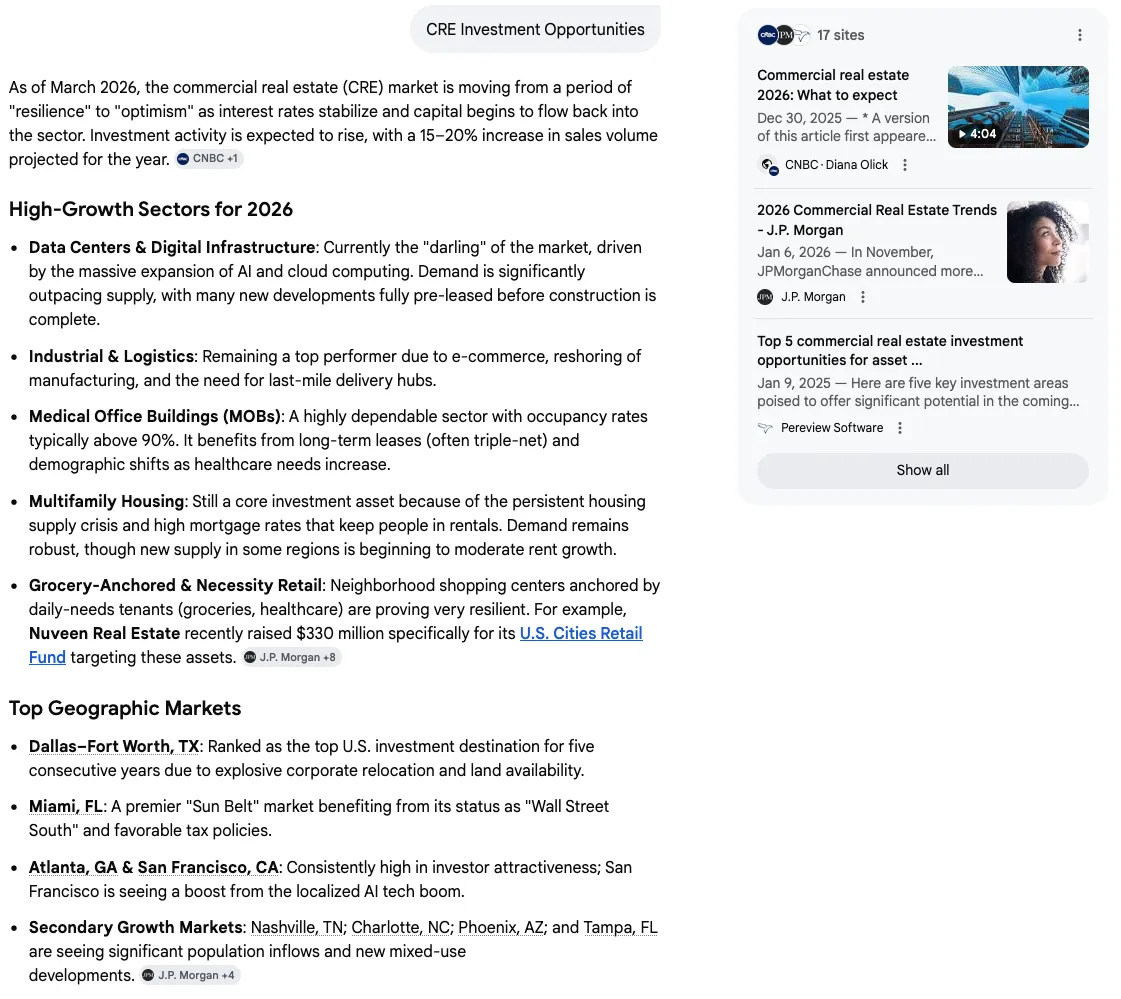
See that even Google Searches often return a Gemini AI answer based on key ungated articles in 2026.
What Should Be Ungated
Ungated content acts as your firm’s public proof of expertise. It is what investors, analysts, journalists and AI-powered LLMs use to understand your strategy, track record and point of view. Keeping this material open improves search rankings, increases AI discoverability and shortens the time it takes for an investor to understand your value.
Commercial real estate firms should typically keep the following content ungated:
- Market commentary and sector outlooks
- Economic perspectives impacting CRE and capital markets
- Investment strategy explainers
- Portfolio case studies and project highlights
- Risk management and ESG frameworks
- Industry trend analysis and research
This type of content builds credibility and positions a firm as a knowledgeable operator in the market. Because these assets are often rich with keywords and insights, they generate far more value when they are searchable and shareable than when they sit behind a gate.
The Role of Social Media and Paid Distribution
Ungated content does its best work when it is actively distributed. Investors rarely discover a firm’s thinking by navigating directly to its website. More often, they encounter insights through trade publications, thought leadership and social content.
When market commentary, strategy explainers and case studies are ungated and shareable, they can circulate across earned media, social channels and paid campaigns, meeting investors where research and early vetting actually happen. Over time, that visibility compounds.
Firms that consistently contribute useful insights across these channels become familiar names in the market. When those same firms later promote gated materials such as full reports or investor briefings, the audience encountering them already understands their credibility and perspective.
What Should be Gated
Gates should be used when someone is clearly evaluating your firm or moving toward a relationship. These moments signal real intent and justify a controlled access point.
Deep diligence materials that may belong behind a gate include:
- Detailed investment decks or offering memorandums
- Portfolio holdings and property-level performance data
- Scenario modeling tools and underwriting worksheets
- Operational documentation and diligence materials
- Proprietary research or internal data sets
Investor-only communications such as quarterly letters, capital calls, distribution notices and fund updates should also remain controlled.
Gated content also plays an important role in targeted outreach and direct-response campaigns. Once credibility has been established through ungated insights and market visibility, deeper materials can be promoted to specific investor audiences through paid campaigns or direct distribution.
In this context, the gate is not a barrier. It is a signal. It helps identify investors or partners who are ready to move from general research into deeper evaluation.
How CRE and Investment Firms Should Use Gated Content
A gate should trigger a human response, not just a marketing automation sequence. When someone requests gated material, it should create a task in your CRM, prompt a personalized follow-up, and support a real conversation with your team. If it does not provide a meaningful signal of intent, it is not worth gating.
Most firms already know who their priority prospects are. What they need is deeper context about:
- Risk tolerance
- Investment time horizon
- Strategy alignment
- Where someone sits in their diligence process
Instead of simply collecting email addresses, gated experiences should capture more meaningful qualification data. For example:
- Investor type
- Accreditation status
- Assets under management
- Geographic focus
- Strategy interest
- Relationship stage
When integrated with CRM and marketing automation systems like HubSpot, this information becomes an intelligence layer that helps firms prioritize outreach and tailor investor communications. This is where marketing, investor relations, data strategy and compliance begin to intersect.
When used correctly, gates enrich first-party data rather than simply capturing contact information.
The 2026 Framework for Gated Content
The modern framework for gated content is straightforward. Keep educational and trust-building insights open so investors, analysts, and AI platforms can easily understand your thinking. Gate only the materials that signal real intent or belong within an existing relationship.
This approach creates a cleaner investor journey, strengthens your brand authority, and provides better signals about who is ready for a meaningful conversation.
Post Summary: Gated Content Strategies for Commercial Real Estate
- Gated content should function as a qualification tool, not a high-volume lead generation tactic.
- Ungated insights improve discoverability across search engines and AI platforms such as ChatGPT, Gemini, Copilot and Perplexity.
- Most investors encounter firms through earned media, LinkedIn commentary, conference coverage, and industry research before visiting a website.
- Thought leadership, market commentary, and case studies should typically remain ungated to build trust and authority.
- Gates are most effective for due diligence materials and investor-specific information.
- A gated download should trigger direct follow-up from a real person, not just an automated nurture campaign.
- Modern gating strategies should capture meaningful investor data, not just email addresses.
- When used correctly, gated content helps identify high-intent investors or partners who are ready for deeper engagement.
FAQs

How to Get Your Press Release Found, Summarized and Cited in the AI Era
Press releases are no longer written just for journalists. Today's releases...

Executive Visibility is a Competitive Advantage for B2B Companies
A practical guide for communications professionals on building an executive visibility...